Kalkkop Impact Crater
Description
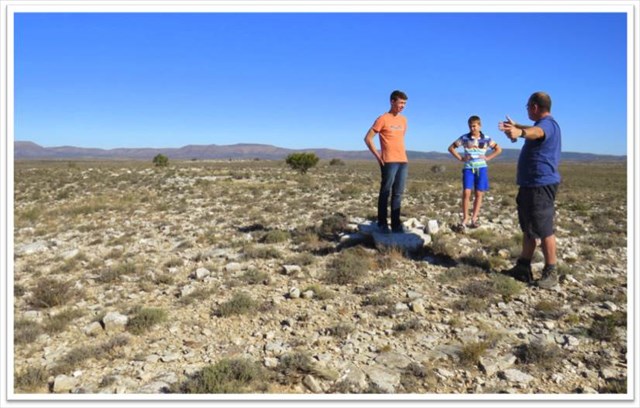
There’s a very interesting spot near Kendrew. It is Kalkkop (“lime hill”) impact crater on the farm Bulrivier. The Smith family have been part of this 5,000 ha farm for seven generations. The original farmhouse was built in 1833. Just getting to this very remote, lonely, low limestone hill among the sandstones and mudstones is challenging and requires quite a bit of skilful driving on at least 70km of dirt roads. Some of these roads wind and twist and eventually end up as ”twee-spoor-paadjies” (double track paths). But those who are up for the challenge will not be disappointed. It is a beautiful, off-the-beaten-track piece of the Karoo.
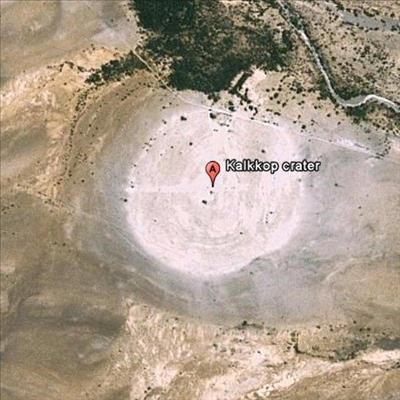
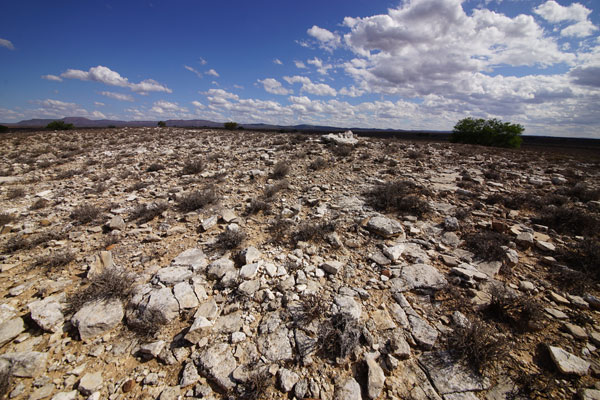
The crater was formed by a 20-metre-wide meteor, which crashed into the Earth about 250,000 years ago during the Pleistocene Period and left a crater 640 metres in diameter and 90 metres deep. After some time, a shallow pool of salty water was formed at the bottom. This evaporated and left a layer of lime which turned into stone. Over the years, more water flowed into the pool and each time dried up, leaving a deposit of lime behind. As the years passed and the Karoo region grew drier, the process continued and gradually the limestone built up, layer upon layer, until it filled the crater and grew up over the edge to form an insignificant little hill about 3 metres high. Today, only a weathered circular ridge – the rim of the crater – is visible on the surface. This fascinating spot was discovered in the 1940s when aerial photos revealed a perfectly circular white deposit. This was presumed to be a crater of volcanic origin.
However, it was not until 1969, after Man landed on the moon, that this was thought to be an impact crater. This was only confirmed in 1992 when another borehole was sunk in the centre of the Kalkkop crater to a depth of 152 metres. Drilling was suspended for a while and later extended to 380 metres. Below that lies fragmented, but typical Karoo rocks – those that were shattered by the impact. This drilling operation also revealed a great deal of scientific information about the rock formations of the crater. This 1992 drilling operation was the first time that the “osmium isotope systematics” technique was used to confirm the impact origin of a crater anywhere on Earth. Kalkkop is one of four confirmed impact sites in South Africa. The others are at Vredefort, Marokweng in the Kalahari – which is virtually invisible – and Tswaing near Pretoria.