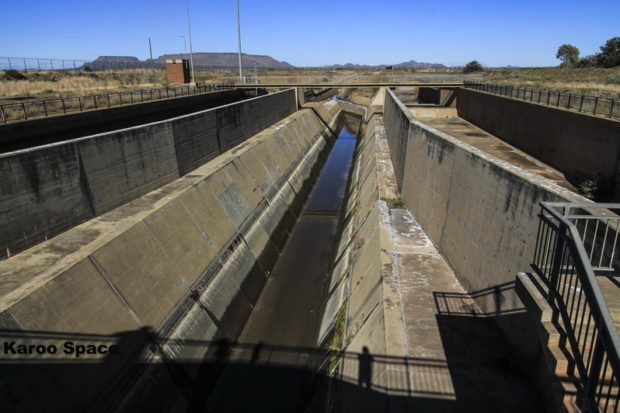
Orange-Fish River Tunnel outlet

Description
One of the Karoo’s most obscure tourism attractions is 150 metres underground, smells faintly of fish and is open to the pubilc for only a few weeks a year.
The Orange-Fish Tunnel is an engineering marvel. Here, under a distinctive flat-topped hill called Teebus between the small Eastern Cape towns of Steynsburg and Hofmeyr, is the outlet end of the world’s third-longest continuous aqueduct, the Orange-Fish Tunnel.
Opened in 1976, the Orange-Fish Tunnel remains one of South Africa’s most outstanding engineering feats, critical for millions of people in the Eastern Cape.
For more than 11 months of the year, an average of 22 cubic metres of water per second from the Gariep Dam thunder through this 82.45km underwater aqueduct under the Suurberg Mountains, supplying the towns of Cradock, Cookhouse, Somerset East, Kirkwood, Steynsburg, Addo, Adelaide, Bedford and the cities of Grahamstown and Port Elizabeth.
The water irrigates crops and dairies in the fertile Eastern Cape Karoo Midlands as well as the multi-million-rand Sundays River Citrus orchards around Addo and Kirkwood.
The Orange-Fish Tunnel becomes a fleeting tourism attraction in midwinter, when the massive cloverleaf intake roller-valves at Gariep Dam are closed. The constant roar of the water quiets to a trickle while a maintenance team from the Department of Water and Sanitation (DWS) comes in.
Dressed in overalls, gumboots and head torches, they splash through this odd world, with the occasional dead or live fish or crab brushing past their ankles in the deeper tunnels as they caulk tunnel linings, fix holes and replace the worn linings of the pepperpot valves specially designed to control the flow of the water.
During these few weeks, visitors (usually curious irrigation farmers and friends) are allowed to see this exceptional place from the inside, as long as there is someone available to guide them around.
Source – Karoo Space