
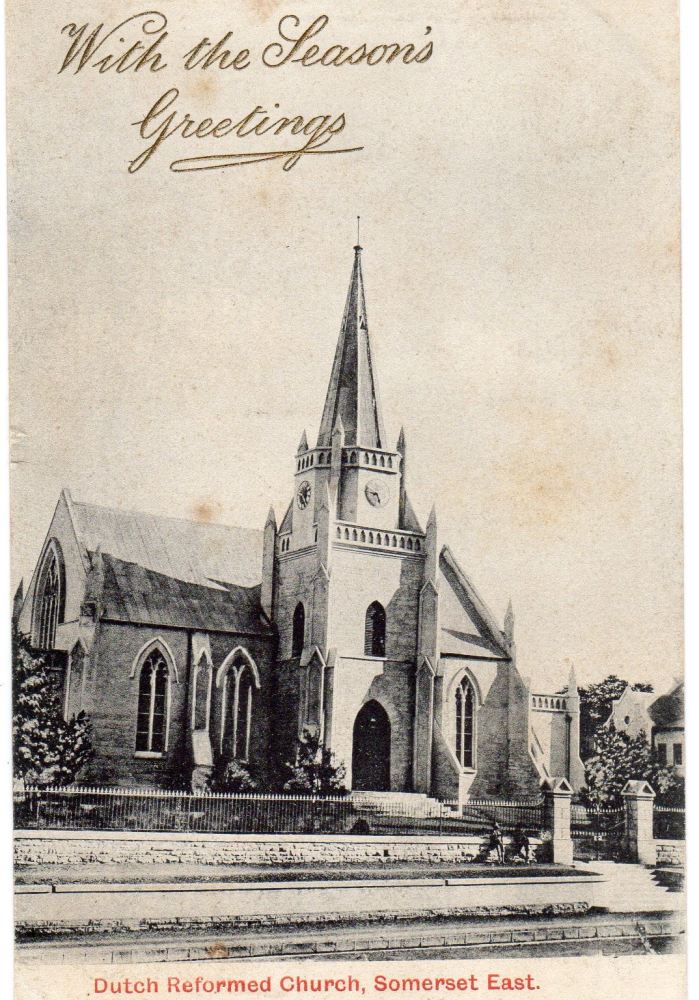
Somerset East Dutch Reformed Church

Description
The Somerset East Dutch Reformed Church is the fourth oldest congregation of the Dutch Reformed Church in the Eastern Cape and the 15th oldest in the entire South African denomination.
Before the foundation of a separate congregation in Somerset East in 1825, the area was split between the Graaff-Reinet and the southern portion of the Uitenhage congregations. The magistrate, William MacKay, was the one who urged a separate congregation. On 27 May 1825, only five months after the Governor of Cape Colony set up the drostdy (“district”) Somerset East, permission was asked for a new congregation and a month later the official go-ahead was given.
In October 1825, the Rev. George Morgan appointed a church council including the elders Robert Hart (also one of Somerset-East’s first three heemraad) and F.J. van Aardt. The congregation was overextended from its foundation. It included the districts of Bruintjes Hoogte, Zwagershoek, Baviaans Rivier, Oost-Rietrivier, and Boschjesmans Rivier. There was no official membership census, but an 1838 poll tallied 2,633 of them.
It would be a while before the congregation could secure its own church building and they worshiped in one of the old government buildings from Somerset Farm. Later, the Governor granted permission to the congregation to worship in the old Drostdy. A piece of land at the southern end of Beaufort Street was secured in September 1826. The keystone was finally laid on 25 December 1830, but the date the church was consecrated is lost. In the early years, two services were held each Sunday, one in Dutch and on in English, until around 1846, when the St. Andrew’s Uniting Presbyterian Church opened in town and English-language services at the NGK church were discontinued.
Somerset-East’s first pastor was the Rev. Morgan who arrived in 1829. He left for a post in the Reformed Presbyterian Church in Southern Africa in Cape Town in 1841, and he was succeeded by the Rev. John Pears. After Pears died in the parsonage, the Rev. Jan Hendrik Hofmeyr, who served from 1867 to 1908, became the congregation’s 3rd minister.
One of the first tasks the Rev. Hofmeyr took on was building a church. The old church had dilapidated thatch and was simply too small. In 1869, therefore, the council decided to build a much larger church on the same land on the southern end of Beaufort Street. Two walls of the old building remained, but the rest was brand new and laid out by the German-born architect Carl Otto Hager. It was dedicated on 17 November 1871, even though the tower was incomplete, the walls unfinished, and the paint job a work in progress,
The church was declared a National Heritage Site in 1979.
—————————————————————————————————————————
The statue in front of the church is that of Rev. Jan Hendrik Hofmeyr, who served as minister to the congregation in Somerset East from 1867 to 1908. Hofmeyr married a daughter of the Rev. Andrew Murray, and just like Ms Hofmeyr’s parents, they had five sons who all became pastors. One of the sons, John Murray Hofmeyr, was curate from 1907 and succeeded his father as pastor from the latter’s death the following year until 1940. Thus, in its first 115 years in existence, the congregation had only four pastors.




Contact Info
- Somerset East