St Peter’s Anglican Church and War Memorial
Description
Bishop Gray’s fIrst visit to Cradock was in 1848. After a brief stop at Somerset East he spent the night in his wagon, arriving at Cradock on 3 November 1848. He wrote, “I fInd here a Dutch Church, Wesleyan and Independent Chapels, but no English Church.” Gray stayed the night with a Mr GilfIllan and the next day, Saturday 4 November, he met with church people.”
On Sunday 5 November, Gray conducted a service in the Dutch (Reformed) Church. The memorials drawn up by the church were sent to the Governor, Sir Hany Smith, and on 5 September 1849 a site was granted to the church. During the Bishop’s 1850 visitation to Natal and the Eastern Cape, he arrived in Cradock on 18 October, staying at the home of Rev Samuel Gray, the priest he had sent there. Rev Samuel Gray (no relative of the Bishop) had arrived in Cape Town on 1 January 1850 as Priest-in-Charge of Cradock. Within a month he was in the town where he stayed with Major Gilfillan. The first services were held in the local Court House.
Gray stated clearly, “There will be no pew rents – Everything will be left to the free will offerings of the people, because the church’s “very existence amongst them [the members] depends upon their offerings.” Gray then added, “My wife will furnish you with plans & working drawings for your church, if you will tell her how many you want it to contain – the length & breadth, the materials of which it is to be constructed, & whether you wish it to be built so as to be capable of future enlargement. Have you any choice as to its style? Early English (like Mainsforth Church) is the cheapest. Do you propose to have it thatched or slated? I am disposed to think you should build for 150 or 200 – not more.”
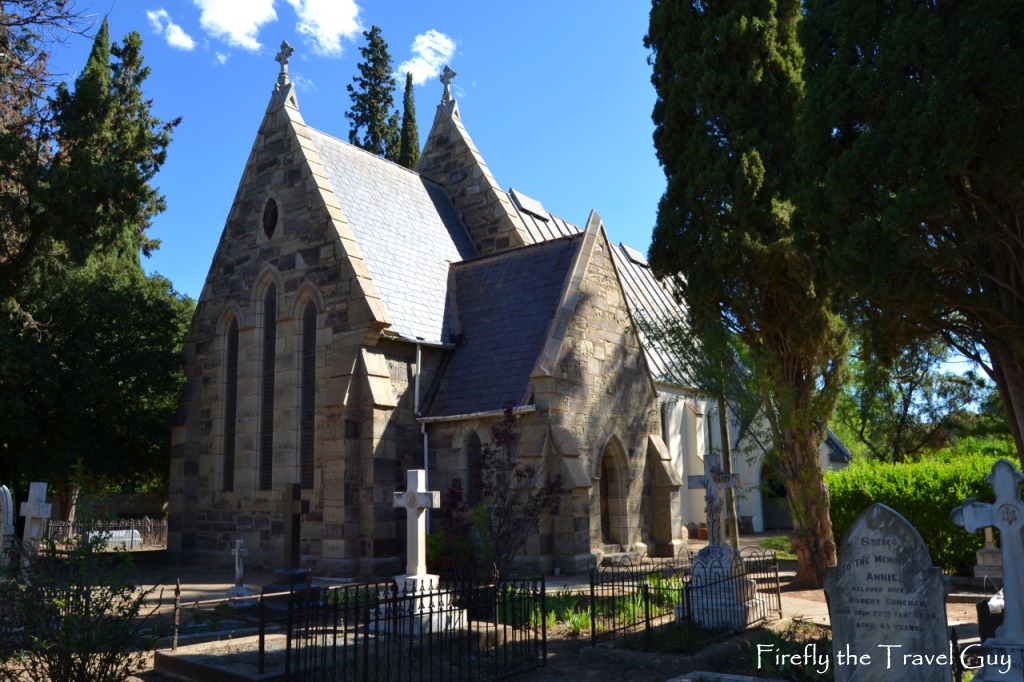
The foundation stone of the church was laid by Mr Christopher M Thornhill of the farm “Raasfontein, on 19 March 1857, nearly six years after Bishop Gray’s detailed instructions for the church building had been written. The event was fully reported in the Anglo-African, Grahamstown. They had been informed of the following details about the church. “The building will consist of a nave and chancel in the Gothic style of the 13th century, with a pitched roof, the timbers open and wrought, covered with slate. The north and south walls will contain five single light lancet windows; the eastern window, three lights, and the western window two. The entrance door will be in the south-west end of the building: the western gable will be surmounted by a Belfry, and the eastern by a stone cross. At each of the angles will be a single stage buttress, and likewise one in the course of the north and south walls. The building is of brick, and is being erected from plans prepared by W. Stitt Esq. RE. The cost will be about a thousand pounds exclusive of fittings.”
The years between 1851 and 1857 had seen the end of the Eighth Frontier War in March 1853 that had started on Christmas Eve 1850, the short but influential ministry of Bishop Armstrong (1853-1856) and the departure of Rev Samuel Gray from Cradock in 1855. Rev Gray was succeeded in 1856 by Alexander Urquhart in whose ministry St Peter’s Church was completed in 1858, ” … of random rubble with steeply gothic roof, originally of slate, at a cost of £1000.”
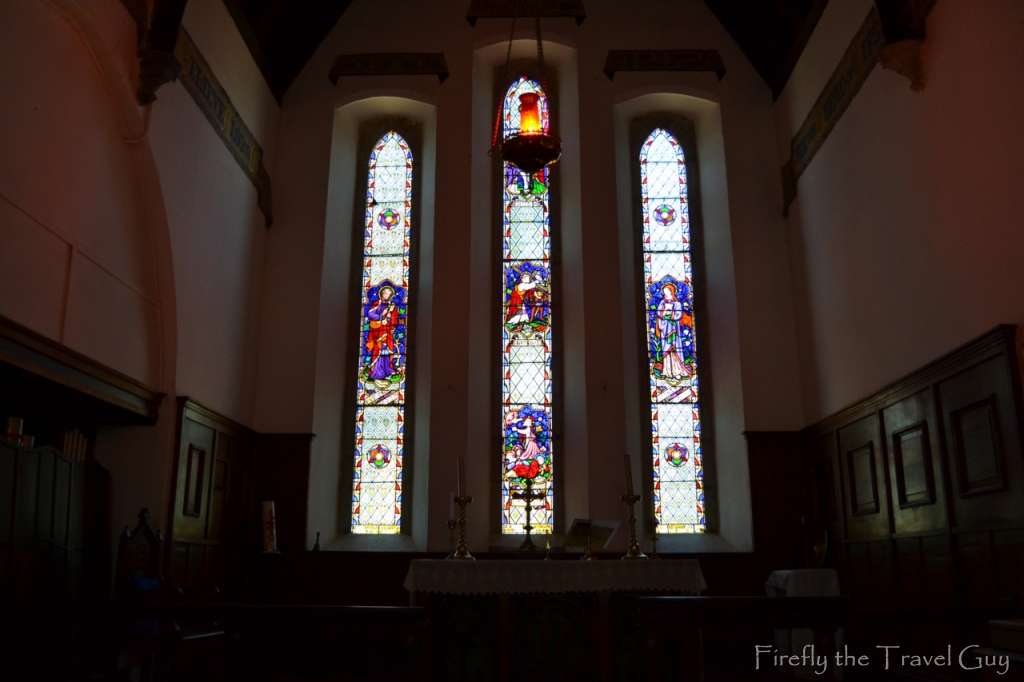
Urquhart gave 20 pews in memory of the Bishop of Aberdeen, Scotland, as well as nine stained glass windows and the stone font. Bishop Cotterill visited Cradock for a few days in 1858, arriving on Friday 18 June. On the following day he confirmed seven candidates ”being the first service held in the church, now nearly completed”. There were two full services on the Sunday and on Monday afternoon [21 June 1858] the Church, dedicated to St Peter, was consecrated.
The article in the Anglo-African of 16 April 1857 states that plans were “prepared” by W Stitt, Engineer. Nearly six years earlier, Bishop Gray’s letter of 27 September 1851, read, “My wife will furnish you with plans and working drawings for a church”. Mrs Gray’s designs for St Peter Cradock was to be
checked by W Stitt, RE. Irrespective of what Stitt had to add from a technical standpoint, Sophia Gray’s influence on the design is obvious – the lancet windows, diagonal buttresses, bellcote (as reported in July 1858), and a steeply pitched roof with exposed arch-braced trusses. It would appear that the church was a basic design by Mrs Gray (possibly based on one of the Grays’ English architect’s drawings), but that Stitt had been requested to adjust her working drawings. Modifications may have become necessary as Sophia’s design was submitted in 1851 and building only began in 1857. Nevertheless, as Mrs Gray, through the Bishop, had final approval of the plans, authorship of the design remains with her.
Source – The churches of Bishop Robert Gray and Mrs Sophia Gray
An historical and architectural review by Desmond Keith Martin
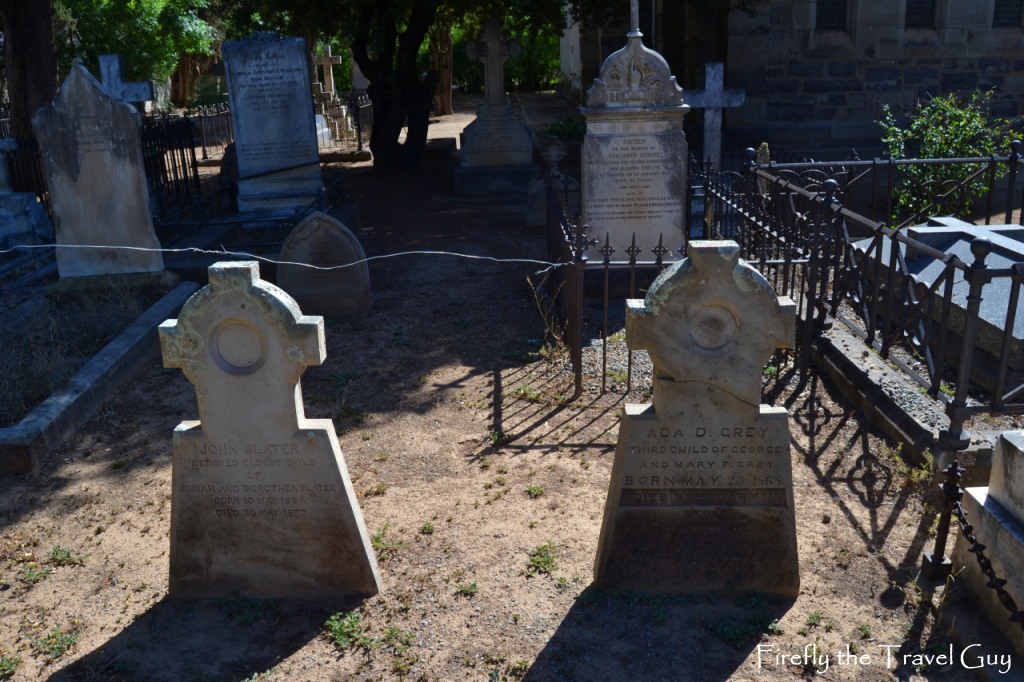
A number of family crypts were built underground in the churchyard. In one of them lie the remains of a Danish lion catcher’s son. Toger von Abo, one of the famous ‘Danes of Cradock’, set up cages on the town square for the lions he captured and sent on to Europe.
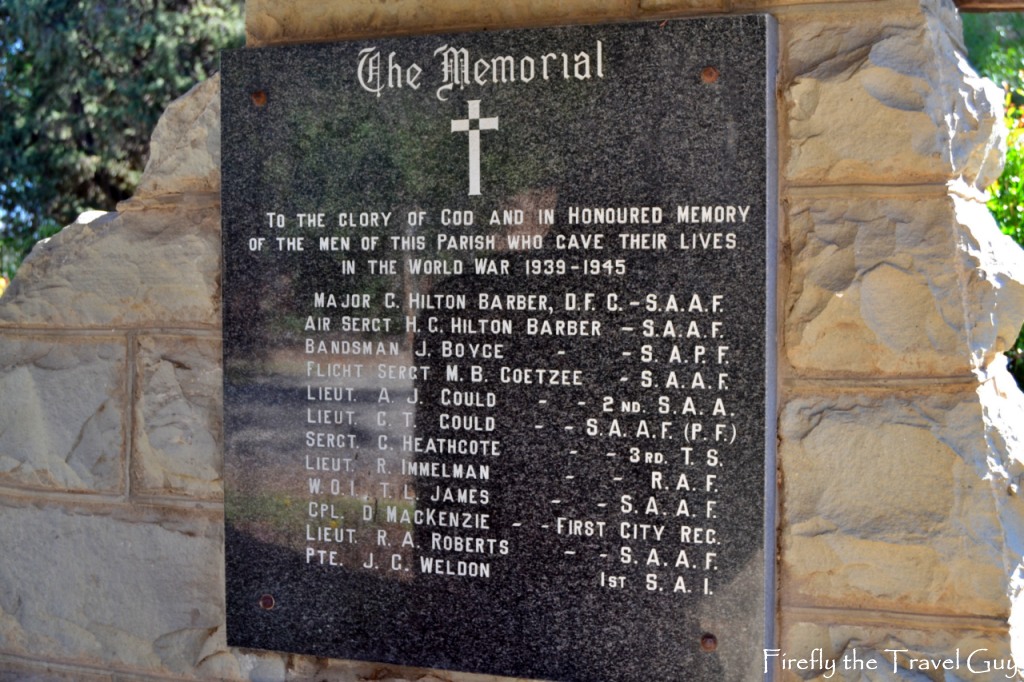
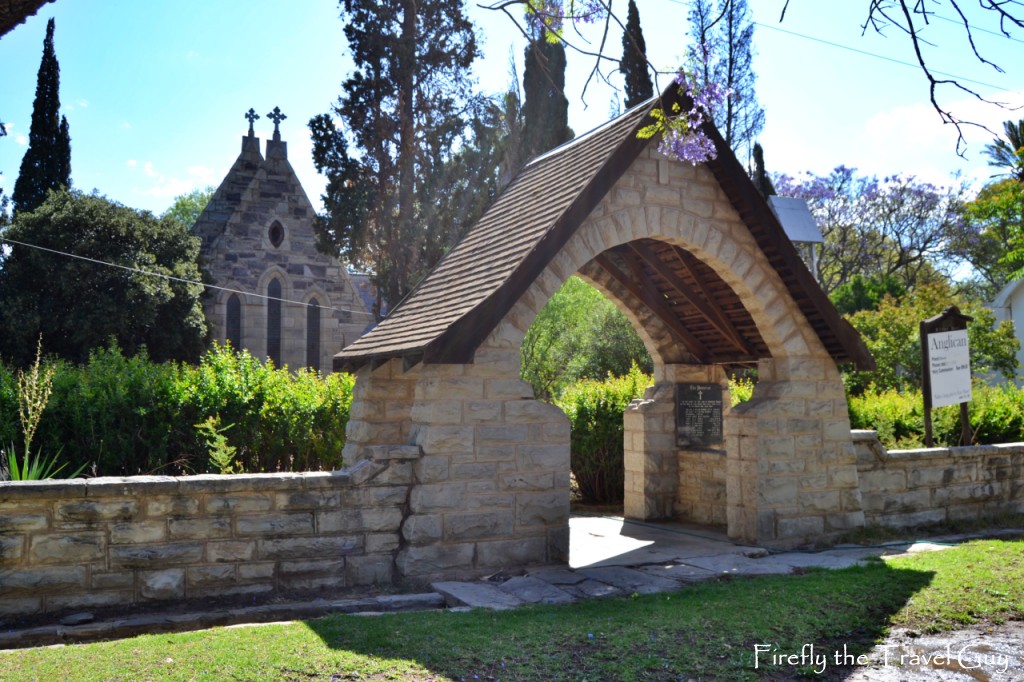
A charming lychgate and stone wall, built to commemorate the parishioners who fell in WW2, is a much later addition to the church grounds.