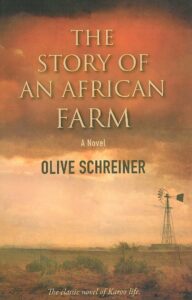
Olive Schreiner (1855-1920) was many things in her lifetime. Among them a political activist, feminist and author of the world-renowned novel, The Story of an African Farm.
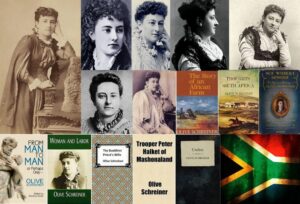
Olive, the ninth (of 12) child of missionaries Gottlob and Rebecca Schreiner, was born at the Wittenbergen Mission near Lady Grey close to the Lesotho border on March 24 1855. Three of Olive’s male siblings, Oliver, Emile and Albert, died young. She was named Olive Emilie Albertina after them.
At nine Olive’s younger sister, Ellie, just two, died. Ellie’s death made Olive a freethinker, rejecting formal religion for what we, today, would call agnosticism. Freethinkers were not that unusual in England then, but were usually at least in their 30s and 40s. Olive was an adolescent, she was a girl and she had almost no formal education. What was extraordinary was that her crisis of faith had occurred in a particularly closed culture, in which a system of theology co-terminus with family authority had not yet been challenged.
When Olive was just 10,her parents had to farm their children out to whoever would take them because they could not afford to look after them. Olive began a peripatetic existence, living with friends or family at Cradock, Barkly East, Hermon, Aliwal North, Dordrecht, New Rush (Kimberley) and Fraserburg.
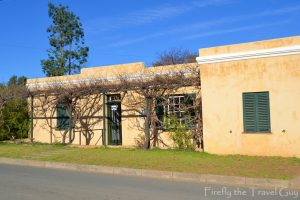
Olive went to Cradock in 1867 when she was 12. Her brother Theo who was 23 and was headmaster of the local public school after teaching for four years in Grahamstown, was head of the household, with their sister Ettie (17) as housekeeper. In the following year their younger brother Will, then 11, joined them.
The house they lived in, one of the oldest dwellings still standing in Cradock, can be found at 9 Cross Street and has been turned into a museum. In the Schreiner House are Olive’s personal library, exhibitions depicting her life and those of her siblings and copies of all the books she wrote. The house contains antique furnishings, an exhibition on the life and work of Schreiner and her siblings, and a small but invaluable collection of books from Olive Schreiner’s and her husband Cronwright’s personal libraries.
The four remained together until 1870, when Theo and Will went to seek their fortune at the diamond fields. Ettie stayed in Cradock to run the small school; Olive, at the age of 15, left to become a governess first in the Colesberg area and then around Cradock, completing The Story of an African Farm at Gannahoek.
Schreiner then moved to England intending to study to become a nurse, which did not work out. Her fame and intellect gave her access to influential writers and thinkers though. She returned to South Africa in late 1889, aged 34, to reconnect with the Karoo because its dry climate was kind to her asthmatic condition, which began in her late teens and plagued her for most of her life.
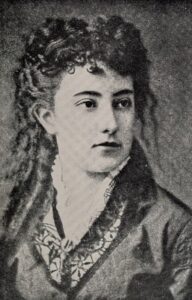
Between 1890 and 1892 she lived in Matjiesfontein before moving back to Cradock. It was in Matjiesfontein that she wrote a series of essays published later as Thoughts on South Africa.
In 1894 Schreiner, aged 38, married Samuel (Con) Cronwright, a Cradock farmer eight years younger than her. He, unusually, added her surname to his. They lived briefly on his farm, Kranz Plaats, but moved to Kimberley because farming activities were said to have aggravated her asthma.
The couple were living in Berea, Johannesburg, in 1899, with war looming between the British and the Boer states. Schreiner wrote several anti-war pieces. During the war Schreiner moved to Wagernaarskraal (Beaufort West is the nearest town). Cronwright took up legal studies and opened an office in Hanover. Here, the Schreiners lived with Nkita their dog and a family of meerkats, which she took for walks on the veld.
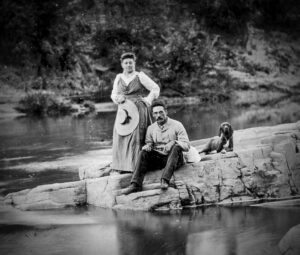
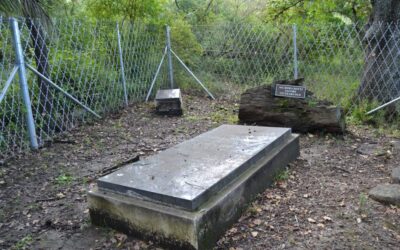
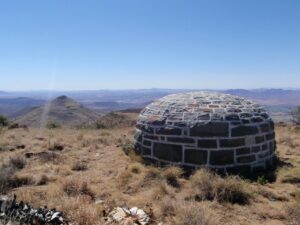
Olive Schreiner died in a boarding house in Wynberg, Cape Town, aged 65 in December 1920. Her attachment to the district is evidenced by her desire to be buried on Buffelskop, south of Cradock, where in 1921 she was re-interred in a sarcophagus. In the grave with her, in separate coffins, are Nkita, Samuel and their unnamed daughter.
Excerpts from Story of an African feminist By Kevin Davie, published in Mail and Guardian, 20 April 2019.